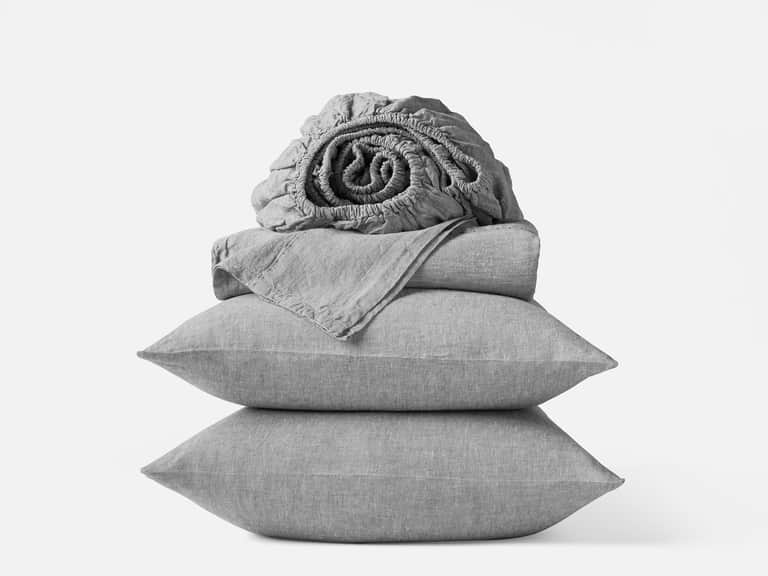
The Luxury Sheet Guide
What Luxury Sheet Specifications Really Tell You: A Naturepedic Guide
Thread count, fiber length and weave each reveal something different about how sheets may feel and wear. The art is in reading them together—not allowing one impressive number to make the decision for you.
Published November 2, 2026
Shopping for luxury bed sheets can feel like deciphering a private language. Labels offer thread counts, fiber names, weave descriptions, certifications and country-of-origin details, all competing for attention. Yet a high number is not a complete measure of quality, and the word “luxury” does not tell you whether a sheet will feel cool and crisp, fluid and smooth, or softly rumpled against the skin.
The useful question is not simply, “How many threads?” It is: What is the fiber? How has it been spun and woven? What kind of surface does that construction create? And does the resulting fabric suit the way you sleep and the level of care you are happy to give it?
Naturepedic’s organic cotton percale, sateen and Supima cotton options make a helpful case study in reading specifications with care. They show why thread count matters—but only in context—and how fiber quality and weave can be more revealing than a headline figure. This is a guide to understanding the details before you choose, so the sheets you bring home feel considered rather than merely well marketed.
Thread count: a clue, not a verdict
Thread count, often abbreviated as TC, refers to the number of threads woven into one square inch of fabric. Traditionally, the calculation combines threads running lengthwise, called warp, with those running crosswise, called weft. It can provide a useful point of comparison when fabrics have similar fibers and construction, but it cannot describe every aspect of their feel or performance.
A sheet’s hand is shaped by several variables: the fineness and length of its fibers, the way yarns are spun, the weave structure, finishing treatments and the fabric’s weight. Two sheets with the same stated thread count may therefore feel quite different. One might feel airy and crisp; another may have a smoother surface and a more fluid drape.
It is also unwise to assume that the largest number signals the finest fabric. Very high figures can be difficult to compare across brands, particularly when ply counting conventions differ. In a two-ply construction, two yarns are twisted together to form a single thread. Some labels may count the individual plies in ways that make a figure look higher than a single-ply count would. The number alone does not tell you whether the underlying yarn is fine, strong or well made.
A more grounded approach is to compare like with like: cotton with cotton, similar weaves with similar weaves, and specifications that explain how the count was achieved. Then use the number as one piece of evidence among several, rather than as a shortcut to a purchase decision.
Fiber length: the foundation of a smoother yarn
Cotton fibers vary in length. “Long-staple” and “extra-long-staple” describe longer cotton fibers, which can be spun into smoother, stronger yarns with fewer exposed fiber ends. Those yarn qualities may contribute to a refined hand and help a fabric resist fuzzing and pilling over time, although care and construction still matter.
Fiber length is not the same thing as thread count. A fine long-staple yarn does not automatically produce a particular TC, nor does a high TC guarantee long-staple cotton. These specifications answer different questions: fiber length tells you something about the raw material and potential yarn quality, while thread count describes the density of threads in the finished fabric.
Naturepedic’s organic Supima sheet set is a useful example. Its published details identify 100% organic Supima cotton, a 300-thread-count fabric and a two-ply construction. The combination matters more than any one detail. The long-staple fiber speaks to the cotton, while the two-ply yarn construction helps explain why the stated count should not be compared casually with every single-ply 300 TC fabric.
Supima is a trademarked name for American-grown Pima cotton, a long-staple cotton category. When evaluating a claim like this, look for the stated fiber and relevant product details rather than assuming that any mention of “premium cotton” means the same thing. For the Naturepedic option, the maker also lists a tailored hemstitch finish, a 16-inch fitted-sheet pocket, and care instructions calling for a gentle warm wash and low tumble drying.
Read more about the Naturepedic Organic Supima Cotton Sheet Sets for the full set specifications. The listed sizes are Queen, King and California King, an important reminder that the best fabric in the world is not useful if the fitted sheet does not suit your mattress.
Weave is where feel becomes tangible
If fiber is the material and thread count is one measure of density, weave is the pattern that brings them together. Percale and sateen are both cotton weaves, but they create distinct surfaces and different impressions on the bed. Neither is inherently superior. The right one depends on the feel you prefer, your temperature comfort and how you want the bed to look.
Percale: crisp, matte and breathable
Cotton percale typically uses a simple one-over, one-under pattern. That balanced structure gives the fabric a matte finish and a clean, crisp hand. It is often chosen by people who like the sensation of cool, freshly laundered sheets, or who prefer a lighter feel rather than a sleek, close-to-the-skin surface.
Naturepedic’s organic cotton percale sheet set is listed as 300-thread-count GOTS-certified organic cotton. Its description emphasizes a crisp, breathable feel and a matte finish; the sheets are pre-washed and described as becoming softer with use. Those qualities are more informative for someone seeking percale than the number alone. A 300 TC percale is not meant to imitate sateen’s smoothness: its appeal is the particular balance of freshness, structure and airflow associated with the weave.
A percale sheet can feel relatively firm or papery at first compared with a sateen one, especially before laundering. Over time, washing may soften the surface, while the characteristic crispness remains part of its appeal. For warm sleepers, people in warmer climates or anyone drawn to a hotel-like, tailored bed, percale is a natural starting point—not a promise that every sleeper will feel cooler in every room.
Explore the Naturepedic Organic Cotton Percale Sheet Sets for details on sizes, color options, included pieces and care. The listed fitted sheets have 15-inch pockets, so compare that measurement with the full depth of your mattress, including any topper.
Sateen: smooth, lustrous and fluid
Cotton sateen uses a weave in which yarns pass over multiple threads before going under another. That construction exposes more yarn surface on one side, giving the fabric a smoother hand and a subtle sheen. Its drape tends to feel more fluid than percale’s, creating a soft, polished effect that can look especially elegant in a neatly made bed.
Sateen is often the choice for sleepers who value a silky-smooth surface and a gentle, enveloping feel. It can feel warmer or heavier than percale to some people, though actual comfort depends on fabric weight, the room, the bedding layers and individual preference. “Sateen” describes the weave; it does not mean satin, which is a different fabric category and can be made from other fibers.
When comparing Naturepedic cotton sateen specifications, keep the exact product in view. Its organic cotton sateen duvet cover, for instance, is described as long-staple organic cotton in a 400-thread-count sateen, woven with a four-over-one technique. That is a duvet cover, not a sheet set, so its stated construction should not be automatically assigned to every Naturepedic sateen sheet. It can still illustrate how a brand describes the character of its sateen: smooth, softly lustrous and designed to drape.
This distinction is central to careful shopping. Product pages may cover a family of coordinated pieces—sheets, duvet covers and pillowcases—but specifications can vary by item. Check the particular label or product description rather than treating one collection detail as a universal rule. The Naturepedic Organic Cotton Sateen Duvet Cover lists its fabric and construction separately from the sheet-set specifications.
A side-by-side reading of three specifications
Consider three details that may appear on a luxury sheet label: “300 TC,” “long-staple cotton” and “percale.” Each tells you something different. The first indicates a thread-density figure; the second describes the cotton fiber category; the third identifies a weave and gives a stronger hint about surface character. Together, they create a clearer picture than any single term could.
- Thread count: Use it to compare fabrics with broadly similar construction. Do not treat it as a direct rating of softness, durability or luxury.
- Fiber length: Look for long- or extra-long-staple descriptions when you want to understand the yarn’s raw-material basis. Consider the complete product specification, not just a fiber adjective.
- Weave: Use percale or sateen as a guide to the likely surface and drape. Percale tends toward crisp and matte; sateen tends toward smooth and subtly luminous.
- Construction: Check whether a fabric is single- or two-ply when that information is available, particularly when comparing thread-count figures.
- Fit and care: Verify mattress-pocket depth, set contents, wash instructions and any finishing details that affect everyday use.
This method replaces the hunt for one supposedly perfect number with a more personal assessment. A 300 TC percale and a 300 TC sateen may share a count but not a hand. Similarly, a 300 TC two-ply Supima cotton may not be directly comparable to a 300 TC fabric woven with a different yarn construction. Context is what makes specifications useful.
How to choose by the way you like to sleep
Begin with sensation, not status. If you like a bed that feels crisp, light and orderly, percale is likely to be a more intuitive match. If you want a smooth surface with a gentle sheen and more fluid drape, sateen may feel more inviting. If the appeal is a particularly smooth cotton hand paired with a documented fiber specification, examine the Supima details alongside the weave and construction.
Temperature is another useful consideration, but it should not be reduced to an absolute rule. Percale’s open, balanced structure is frequently associated with a breezy feel; sateen’s smoother surface and drape may feel more substantial. Yet the comfort of a complete bed also depends on the duvet insert, mattress protector, room temperature, humidity and personal physiology. If you sleep warm, consider the whole system rather than expecting a sheet alone to solve every temperature concern.
Texture matters, too. Some people enjoy the crispness of percale precisely because it feels fresh and structured. Others prefer sateen’s smooth glide. If possible, compare samples in person or read the weave description before buying. A photograph cannot convey surface feel, and a thread-count figure cannot substitute for it.
Care is part of the specification
Luxury sheets are not simply chosen; they are lived with. Care instructions influence how easily a set fits into your routine and how it may look after repeated washing. Follow the guidance for the specific product, since temperatures, cycle recommendations and drying methods can differ even between cotton items.
For the Naturepedic Supima sheet set, the listed care is a warm gentle-cycle wash, low tumble drying and optional warm ironing. The organic cotton percale sheet set likewise lists warm washing and low tumble drying. Avoid overloading the machine, use an appropriate quantity of detergent, and make sure the sheets are fully dry before storing them. Excessive heat and overcrowded washing can put unnecessary strain on textile fibers and seams.
The aim is not to preserve sheets as if they were museum textiles. It is to keep them clean and comfortable without adding avoidable wear. A well-made cotton sheet should be used; sensible, consistent care helps it remain part of the nightly routine rather than a precious object that is too difficult to maintain.
Certifications and sourcing: what they can add
A fiber or weave specification speaks to material and construction, while a certification addresses a different set of questions. The Naturepedic products described here identify GOTS certification for their organic cotton. Such a label can help shoppers assess sourcing and production criteria within the scope of the standard, but it does not tell you whether a fabric will feel crisp, smooth or warm to you.
Keep claims in their proper lane. Organic certification does not determine thread count. A certification does not prove that a sheet suits your sleep preferences, and a premium weave does not, by itself, establish organic status. The strongest evaluation comes from combining verified material information, construction details, fit, care and your own preferred hand.
A practical label-reading checklist
Before choosing luxury sheets, take a moment to move past the largest type on the label. A considered shortlist can be simple:
- Confirm the fiber composition and whether the cotton is identified as long-staple, extra-long-staple or Supima.
- Identify the weave: percale for a crisp, matte character; sateen for a smoother, more luminous one.
- Read the thread count in relation to the fiber and construction, including any two-ply information.
- Check the exact item. Sheet-set specifications do not automatically describe a coordinating duvet cover.
- Measure mattress depth and compare it with the fitted-sheet pocket, accounting for toppers or protectors.
- Review the pieces included, certification details, country-of-origin information and washing instructions.
- Choose according to the hand you actually want—crisp, smooth, relaxed or softly lustrous—not the number that sounds most impressive.
The quiet luxury of choosing well
A luxury sheet is not defined by a single specification. It is the considered relationship between fiber, yarn, weave, finishing and fit—and the pleasure of finding a fabric that feels right night after night. Thread count helps describe density. Fiber length offers insight into the cotton. Weave explains much of the sheet’s surface and drape. Taken together, these details make the label less like a sales pitch and more like a useful guide.
Naturepedic’s organic cotton percale, sateen and Supima examples show how to make that reading more precise. Percale’s 300-thread-count construction points toward a crisp, matte feel; the Supima set combines named long-staple cotton with a 300 TC, two-ply construction; and the brand’s sateen description demonstrates why a smooth finish must be understood through weave as well as fiber and count. Each specification has a role, but none should be asked to tell the whole story.
The best choice is ultimately the one that aligns technical detail with personal comfort. Read the label, check the item, measure the bed—and let the feel you prefer have the final word.
Frequently asked questions about luxury sheets
Is a higher thread count always better?
No. Thread count is one specification among many and does not independently establish softness, durability or comfort. Fiber quality, yarn construction, weave and finishing also shape how sheets feel and wear. Compare the figure in context rather than selecting the highest number automatically.
Are percale sheets cooler than sateen sheets?
Percale is often described as crisp and breathable, while sateen generally feels smoother and more fluid. These characteristics can influence perceived warmth, but comfort also depends on the room, other bedding layers and the individual sleeper. The weave is a useful clue, not a guarantee of a particular temperature experience.
What does two-ply mean in a sheet specification?
Two-ply yarn is made by twisting two yarn strands together. Since thread-count reporting can treat plies differently, a two-ply fabric’s figure may not compare directly with a single-ply fabric’s figure. Look at the construction detail alongside the count.
What should I check before ordering fitted sheets?
Measure the mattress depth, including any topper, and compare it with the fitted sheet’s pocket measurement. Confirm the mattress size, set contents and care instructions as well. A precise fit is a practical part of choosing luxury sheets, not a minor detail.